26 Oct
SEO Title: What Should a Small Service Business Automate First? A Decision Framework
SEO Meta Description: Overwhelmed by admin? Learn what small businesses should automate first with our practical framework for contractors to prioritize AI and save hours daily. (158 characters)
Recommended URL Slug: /what-should-small-service-business-automate-first/
Target Persona: Service business owners (HVAC, plumbing, electrical, landscaping) overloaded with admin and skeptical about AI.
Primary Intent: what should small business automate first; AI automation for contractors
Supporting Terms/Subtopics: field service automation, reducing admin overhead, AI for contractors, business process optimization, lead response time, human-in-the-loop AI.
Excerpt
Stop letting paperwork eat your evenings. This practical framework helps skeptical service owners identify the highest-impact, lowest-risk tasks to automate first, moving from administrative overload to a streamlined, scalable operation.
What Should a Small Service Business Automate First? A Practical Decision Framework
If you own a service business—whether you’re running HVAC crews, a plumbing outfit, or a landscaping team—you probably didn’t start your company because you loved paperwork. You started it to build something, to solve problems for customers, and to grow a profitable venture.
Yet, as the business grows, the “Admin Trap” begins to close. You spend your days in the field and your evenings at the kitchen table, squinting at job notes, drafting quotes, and chasing invoices. You’ve heard the hype about Artificial Intelligence (AI) and automation, but you’re skeptical. You don’t want a robot talking to your customers, and you certainly don’t want an algorithm making pricing errors that eat your margins.
The question isn’t whether you should automate; it’s what you should automate first to get the most relief with the least risk.
The Core Answer: Prioritize repeatable, measurable, low-risk bottlenecks—then pilot, keep human approval, measure, and scale only after results are proven.
This guide provides a practical decision framework designed for the skeptical owner who needs results, not hype.
The “Low-Risk, High-Relief” Decision Framework
Before you buy a single piece of software, you need to filter your tasks through three specific lenses. This prevents you from wasting time on “cool” technology that doesn’t actually move the needle for your business.
1. Repeatability: How often does it happen?
Automation thrives on patterns. If a task is a “one-off” that requires a different approach every time, it is a poor candidate for early automation. If it’s something you or your team does ten times a day—like acknowledging a new lead or sending a “thank you” after a job—it’s a prime target.
2. Impact: Does it save time or make money?
Focus on the bottlenecks that either stop you from billing or stop you from winning new work. A task that saves you five minutes a week is a distraction. A task that cuts your lead response time from four hours to four minutes is a game-changer.
3. Risk: What happens if the AI gets it wrong?
This is where most skeptical owners get stuck. The key is to start with “Internal-Only” or “Draft-Only” automation. If an AI drafts a quote based on your notes, and you review it before the customer sees it, the risk is near zero. If you let an AI automatically bill a customer without a human check, the risk is high. Start with low-risk drafts.
| Task Category | Example | Automation Priority | Risk Level |
|---|---|---|---|
| Lead Capture | Answering “Are you available?” | High | Low (with human handoff) |
| Quote Drafting | Turning job notes into a PDF | High | Low (Review before sending) |
| Scheduling | Complex multi-crew routing | Medium | Medium |
| Pricing Strategy | Setting margins for a new market | Low | High |
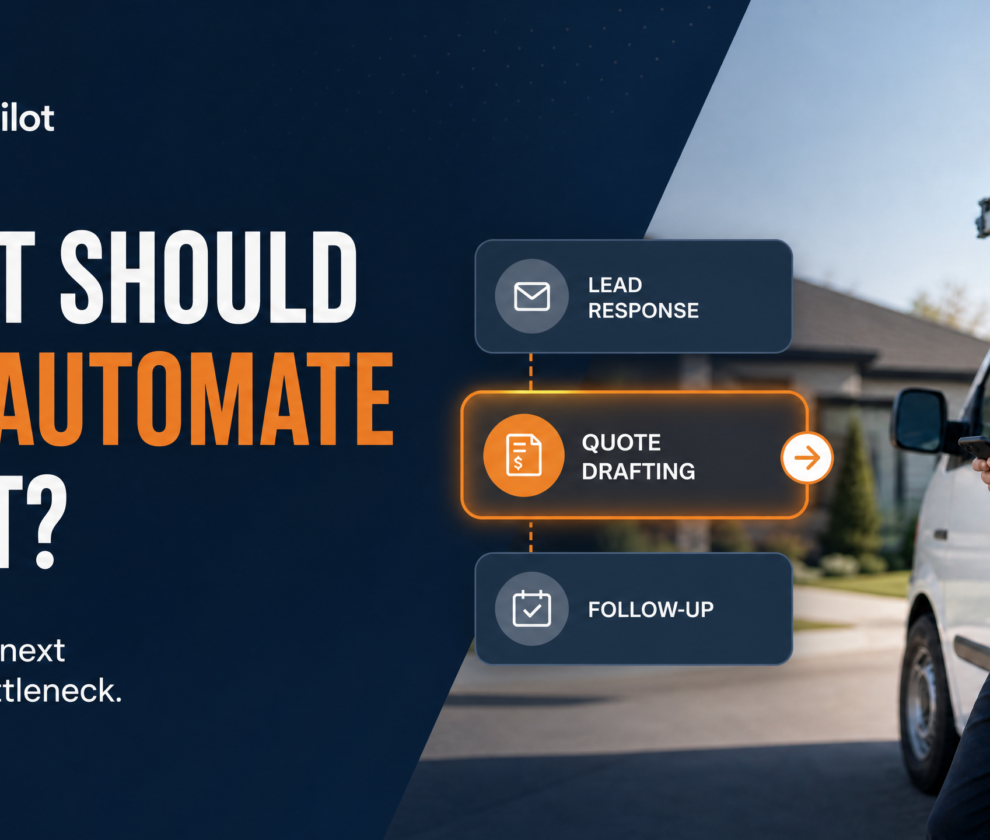
Priority #1: The Five-Minute First Response
In the field service industry, the fastest business often wins the job. Research shows that businesses that respond to a lead within five minutes are 100 times more likely to connect and qualify that lead than those that wait 30 minutes [1].
For most owners, answering every call or text while on a roof or under a sink is impossible. This is your first automation win.
How to automate it responsibly:
1. Capture: Use a tool to capture the lead’s name, service needed, and location.
2. Acknowledge: Send an automated, human-sounding text or email: “Hi [Name], thanks for reaching out to [Business Name]. We’ve received your request for [Service]. We’re currently on a job site but will review your details and get back to you with a next step within [Timeframe].”
3. Notify: The system alerts you immediately so you can take the next human step when you have a break.
This isn’t “replacing” you; it’s protecting the lead until you can get to them.
Priority #2: The “Kitchen Table” Quoting Bottleneck
Most contractors lose their evenings to quoting. You have the job notes, the photos, and the measurements, but sitting down to type that into a professional estimate takes forever.
AI is exceptionally good at organizing messy information. You can now use tools to “read” your voice notes or shorthand job details and turn them into a structured, professional quote draft.
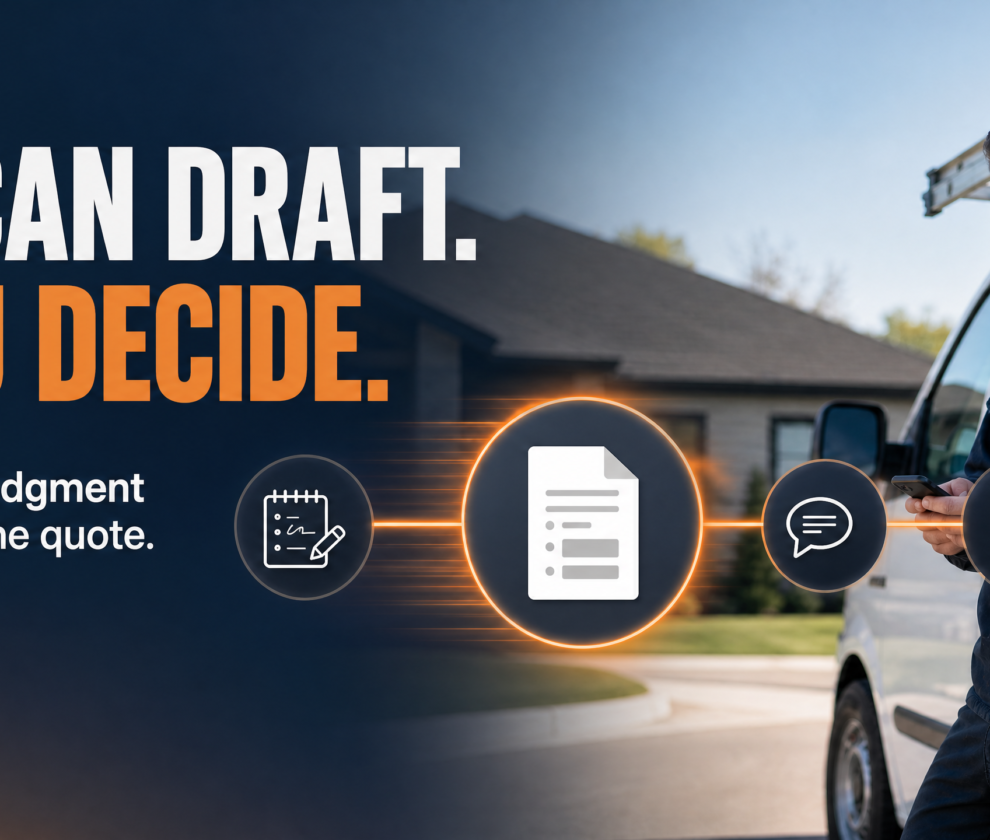
The “Human-in-the-Loop” Rule:
Never let an automated system send a quote directly to a customer. Instead, use automation to create the draft. You spend 60 seconds reviewing the price and scope, hit “send,” and reclaim your evening. This keeps you in control of the margins while the AI handles the formatting and data entry.
Priority #3: Closing the Loop (Invoicing and Follow-Up)
If you’ve finished the work but haven’t sent the invoice, you’ve essentially given the customer a 0% interest loan. Small service businesses often struggle with “administrative lag”—the time between finishing a job and getting paid.
Automating the transition from a “Completed Job” to a “Sent Invoice” is a high-impact, low-risk move. Similarly, automating a follow-up message three days after a job to ask for a review or check if everything is working correctly builds massive customer trust with zero ongoing effort.
How to Pilot Your First Automation
Don’t try to overhaul your entire business in a weekend. Follow this 90-day pilot approach:
- Identify one bottleneck: Choose either lead response or quote drafting.
- Define the “Success Metric”: For example, “Reduce time-to-first-response to under 10 minutes” or “Save 4 hours of paperwork per week.”
- Select a Tool: Look for industry-specific tools like WyzPilot that are built for field service, rather than generic AI tools that don’t understand contractor workflows.
- Run a 14-day test: Keep your old process running in parallel if you’re nervous. Compare the results.
- Review and Adjust: Is the AI sounding like you? Are the drafts accurate? Adjust the prompts or settings before you scale to other parts of the business.
A Note on Professional Advice
While automation can streamline your operations, it is not a substitute for professional expertise.
Disclaimer: This framework is for educational purposes. Automation decisions involving legal contracts, tax calculations, insurance requirements, or regulatory compliance should be reviewed by qualified professionals in those respective fields. Always ensure your data handling practices comply with local privacy laws.
Frequently Asked Questions
Q: Will automation make my business feel cold or robotic?
A: Only if you let it. The goal of good automation is to handle the “data” so you have more time for the “relationship.” A fast, helpful response feels better to a customer than a six-hour silence.
Q: Is AI expensive for a small business?
A: Many tools offer free trials or low-cost tiers for small teams. The real cost to consider is the “opportunity cost”—how much is a lost lead or four hours of your time worth?
Q: Do I need to be a “tech person” to set this up?
A: No. Modern tools for contractors are designed to be “mobile-first” and simple. If you can send a text message and take a photo, you can use modern service automation.
Q: What if the AI makes a mistake in a quote?
A: That is why we recommend the “Human-in-the-Loop” approach. The AI drafts; you approve. You remain the final authority on every price and promise sent to a customer.
About the Reviewer
SohoWizz Technology Solutions specializes in helping small businesses deploy AI in a controlled, secure, and accountable way. We focus on practical automation that strengthens business foundations without creating new risks.
Take the Next Step
Ready to stop the admin bleed? Start with a tool designed specifically for the way you work in the field.
Try WyzPilot free or See the live demo to see how you can turn job notes into professional replies and quotes in seconds.
References
[1] Harvard Business Review: The Short Life of Online Leads[2] Small Business Administration: Automating Business Processes
[3] WyzPilot: Field Service Automation Guide 2026